


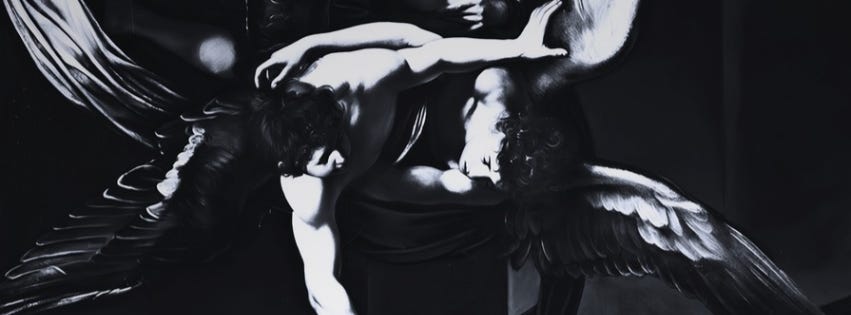
“In the eternal silence of the soul, when all matter is stripped from men, what remains?”
We all ask the smoldering question at a certain point or another. We may understand that we all must perish at an unexpected point in life, and this contemplation of uncertainty of what life may be concludes with who or what is the person living within.
Some approach this question with a religious response with the hope that within it, is a remedy to ease the wound of bearing such a question on the conscience. Other individuals intentionally throw themselves into the lion’s mouth in pursuit of a philosophical answer that fits their conception of reality rather than submitting to comfort. Commonly, these two forms of thought today are divorced from one another and rather rare to truly indulge in as one principle.
It could be the case that we have grown to desire leisure rather than knowledge. In an age where the answer to sorrow is material, if contemplation over immaterial causes you sorrow, discomfort or stress, then it’s best not to be concerned with it and discard the idea.
Historically, this has not always been the case.
Thomas Aquinas, the Catholic theologian and philosopher, approaches this question using these two ways of thinking as threads for a greater fabric of understanding reality— using divine revelation intertwined with reason, fueled by the good pursuit that is understanding. Recording his argument in his commentary on Aristotle’s De Anima, Aquinas pursues this question head on, despite the possibility that it may fracture his Catholic identity and offend his comfort.
Perhaps the answer to this agonizing question may be found in his writings; offering greater comfort, or perhaps digging a greater wound.
‿̩͙⊱༒︎༻♱༺༒︎⊰‿̩͙
He first asks that all presuppositions one may have be put aside, allowing the individual on the receiving end to fully consume the response presented. Aquinas begins his argument by presenting two distinct ways of asking about a thing: (a) when discussing a thing we do not mention what it is, and (b) when discussing what a thing is—refers to its essence. Concluding with these two points, he provides the idea that all things in existence are composed of these two things, the matter and form or essence of that very thing.
An analogy one may use in order to understand this distinction is that of a flower. Supposedly speaking, say I love a flower. Unfortunately due to our corrupted and withered nature—which I believe is rather obvious to us all—I am likely drawn to the aspects the flower presents materially: her color, fragrance, and shape. Yet, to truly understand her, and consequently love the flower, would be to bring into awareness that these things are not by themselves what the flower truly is. These material attributes belong to the flower because there is something that makes her one of a kind.
Therefore when we encounter something such as this flower, the senses are first drawn to the material attributes of said flower, whereas her form or essence relates to her very being—what she is. Now I understand what you may be thinking: what does this have to do with a soul?
Well, this flower I mentioned we now understand is composite—composed of matter and form. Aquinas presents the idea that despite the way the flower may bloom today, does not call into question her form, rather that her beauty is a consequence to her essence, the same way the flower is no less flower as when she existed as merely a seed. Her blooming was the actualization of her potency—the capacity for change, already present within herself.
Therefore it follows, to love said flower is to love not just what we may know through the senses, but rather the entirety of her being—the very thing that possesses her that makes her that flower and the capacity to become another way. This presents the distinction between what we know to be the case and what truly is.
Now that we understand this concept, which in philosophy is commonly associated with hylomorphism, we can now approach the human composition. Substances are generally reckoned bodies, especially natural bodies. Yet, as we understand them, living things tend to tragically die. Once mourning ends, we may come to the understanding that when death occurs, the body generally still exists. The body is present among us, yet, is dead, no longer containing what we call life. Therefore a distinction is presented, we understand that some bodies have life and some do not. The body's existence relies on life, and when it is without, it decays, reducing the body to have the capacity to live rather than containing the property of living.
Now knowing this, you may ask the question: what exactly makes a living body living if not itself?
Once again, the body and life cannot be one in the same, as the body persists after death. We must henceforth maintain the difference between the living body and the dead body, the state of the individuals being, and their body, for what makes the individual and their body unique is not the body itself. Saint Thomas Aquinas calls this the soul, or simply, the form of a living thing or body—what first makes the body a living thing, and ultimately, making who or what they are; union among material and immaterial, yet distinct; the first principle of the human experience.
Following this concept, the body does not function as a monstrance for the soul, nor is the body and soul two things temporarily joined together without relation. Rather, what is believed by Thomas is that the two are weaved into one another existing as a human, the very person they are.
This now allows us to imagine something perhaps gloomier.
What exactly is it that remains when our bodies decay if the soul is the form of said body? Despite an individual’s body decaying and returning to the earth that bore it, what occurs to the very thing that made this corpse familiar to those who loved it? Where is this said soul of an individual that once animated them?
We obviously understand that we can refer to dead individuals. What remains is certainly not the completion of their humanity, rather, that which brought them into being. Perhaps they are living, but no longer complete—hence, the soul; the very thing that animates us, and in the rational soul, the things that allow one to understand what we truly are.
Perhaps after death, we are merely a metaphysical mangled mess.
‿̩͙⊱༒︎༻♱༺༒︎⊰‿̩͙
What I mentioned above is very clearly not the entire substance within the argument presented by St. Thomas Aquinas, but it certainly give us a sufficient amount to play with.
Supposing this argument is true, it allows us to contemplate the experience upon the day of our death. Perhaps, when we are ripped of our material bodies, our soul can no longer rely on the senses, making all that is left pure understanding of what occurred in life preceding it. Maybe in the same way that just because we don’t remember what occurred in our early months or years as children doesn’t call into question our existence during that era, perhaps for the individual, what remains is not memory in the ordinary sense we may refer to, but the fullness of understanding without the distraction of the senses by which we encounter reality—an incomplete and unnatural human experience or torment.
Adopting the Christian paradigm, perhaps one may speculate that Heaven is a distraction from this understanding or its fulfillment. I find it rather difficult that any of us would like to re-experience certain things that occurred in this life without the ability to turn away from the absolute messes we’ve made of our existence. Maybe the horrors and agony of Hell is this exact thing I just described.
In summary, the eternal silence of the soul, where all will be stripped of matter, all that will persist is the human soul separated from the distraction the body may present: faced by either the fiery understanding of the sins committed in the pursuit of temporal pleasures, or the fulfillment of divine revelation—a supposed perpetual bliss beyond all that may be experienced by the senses.
Does this argument prove that there is a soul?
Perhaps not. Or at least not yet.
We have merely scratching the surface of St. Thomas’ argument and the overall mystery of this soul wrought of a Divine. Here, this exact mystery of the human may never be answered, but likely will continue to be explored.
Let us then, allow the vault of Heaven and all of its wisdom to shine down upon us, allowing all hidden things to be illuminated. For as St. Thomas writes:
"Of all the pursuits open to men, the search for wisdom is most perfect, more sublime, more profitable, and more full of joy."
- Saint Thomas Aquinas, The Angelic Doctor
May God Bless you all,
Ismael
✦